What is a MindFile?
The software layer that must precede the hardware transition.

The Missing Architecture: Why Your Digital Footprint Is a Tragic Category Error
There was a time when preserving a life meant carving a name into stone.
Later, it meant ink on parchment, letters tied in string, tucked away in cedar chests. Then came photographs, home videos, social media, and smartphones that could document nearly every waking second of our existence. Each generation became exponentially better at recording the superficial data points of living.
And yet, walk into any antique shop, look at a black and white photograph from a hundred years ago, and you will feel the cold truth of the matter… Something essential is always missing.
If someone discovered your hard drive or your iCloud photo library two centuries from now, they would know exactly where you traveled. They would know what your face looked like, what you ate on vacation, and perhaps even what music you streamed on the commute.
What they wouldn’t know is who you were.
They wouldn’t understand why you abruptly changed careers at thirty-five. They wouldn’t see the single, quiet conversation that completely shattered and rebuilt your worldview. They wouldn’t know why losing a parent fundamentally reshaped the way you loved your own children, or why you chose one specific path when another seemed equally alluring.
Those critical pivot points aren’t captured in photographs. They aren’t text files.
They are patterns. They are the invisible, synaptic architecture that makes one human being fundamentally distinct from every other. And under our current digital paradigm, almost none of it survives.
The Difference Between Recording a Life and Preserving One
For centuries, we have been preserving the evidence of human lives. Very rarely have we attempted to preserve the schema of the human mind.
Those are two entirely different engineering challenges.
Knowing someone climbed a mountain is history; understanding the internal friction, the quiet existential dread, and the specific conviction that compelled them to climb it tells you who they are. Knowing someone founded a company is a line on a resume; understanding the intricate web of fears, compromises, and deep-seated values that drove that decision is identity.
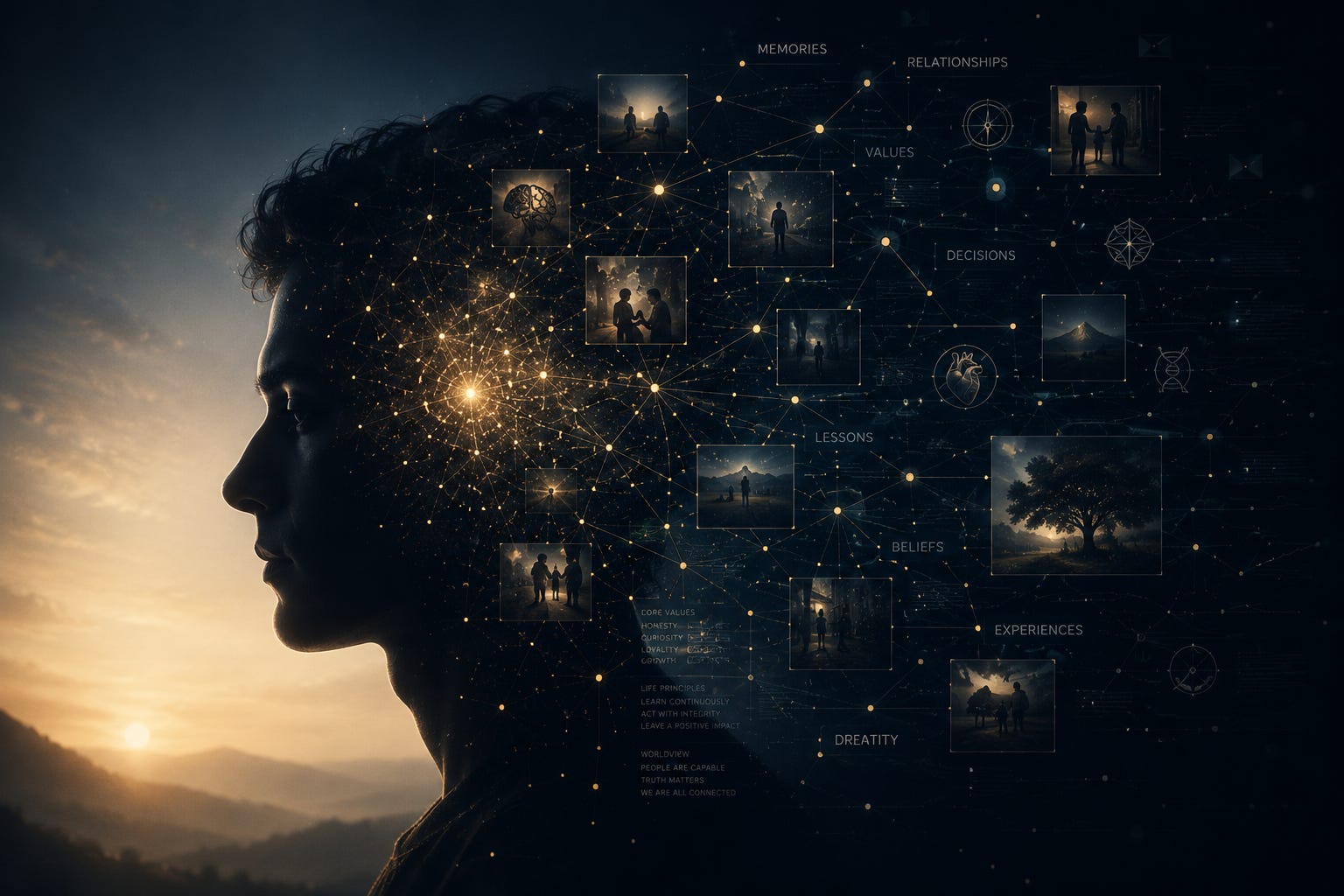
Our experiences do not exist in isolated folders. They are a live network. One memory actively rewrites another. One relationship casts a shadow over every relationship that follows. One profound failure quietly, permanently recalibrates every decision we make moving forward.
A human life is not a linear timeline. It is a highly complex, dynamic graph database.
That is what a MindFile is designed to solve.
A MindFile is not a journal, a diary, or a folder full of markdown notes. It is a structural map of your cognitive baseline. Instead of just asking, “What happened today?” a MindFile isolates the underlying causal logic:
What did this specific experience teach you about your boundaries?
What core value did that conflict reinforce?
Which historical memories shaped the belief you held in that room?
How did this exact moment alter the trajectory of the decisions that came after it?
Over time, these data points stop looking like entries. They crystallize into a high-fidelity, machine readable blueprint. Not of your schedule, and not of your accomplishments, but of the unique architecture of your mind.
The Input Bottleneck: Why This Transcends Journaling
For the tech-forward, the transhumanists, and the cryonicists, this isn’t a philosophical exercise. It is a critical data-engineering bottleneck.
We are living through a massive acceleration of frontier infrastructure. Artificial intelligence is becoming remarkably adept at navigating highly structured graphs. Brain-computer interfaces are migrating out of the lab. Cryonics organizations are successfully preserving biological structures for future medical revival, and DNA storage promises information lifespans measured in centuries rather than decades.
But all of these technologies share a single, glaring vulnerability: They depend entirely on the quality of the input data.
The future cannot reconstruct what was never captured. If a synthetic neural substrate or a future reanimation team tries to piece you together using nothing but your flat digital footprint, your fragmented emails, slack logs, and performative tweets; they will inevitably build a hollow, algorithmic caricature. If your brain undergoes even minor information-theoretic decay during long-term vitrification, an inefficient text archive cannot patch the holes in your logic gates.
The better we become at extending life, the more critical cognitive continuity becomes. Living longer, or being spun back up, is useless if your core reasoning matrix is overwritten by a hosting provider’s default weights. You need an independent, sovereign software layer to precede the future’s hardware.
Who Inherits the Framework?
The obvious adopters of a MindFile are the power AI users who want to air-gap their context windows from corporate monopolies, or transhumanists designing for substrate independence. But that framework is far too narrow.
A MindFile is for the founder whose enterprise is built on years of unwritten, intuitive judgment. It is for the researcher whose greatest contribution is their specific pattern-matching ability. It is for the artist whose work reflects an evolving, intricate philosophy.
And, perhaps most fundamentally, it is for anyone who has ever stared at a problem and thought, “I wish I could still ask my grandfather how he would have reasoned through this.”
A MindFile exists because, one day, someone is going to ask those exact questions about you.
Why We Engineered Embermind
When we started building Embermind, we explicitly refused to build another passive note-taking application. The world does not need another digital scrap piece of paper.
What obsessed us wasn’t the act of writing; it was the problem of continuity.
How do you preserve enough deep, structural context that an external system, or a future generation, can understand not just what you concluded, but exactly how you reasoned? How do you preserve relationship dynamics instead of static contact lists? Core memories instead of lossy timestamps?
That obsession became Embermind.
Every single entry within the ecosystem is mathematically designed to become part of something larger than itself: a fully private, local-first, zero-knowledge Synaptic Map. It is a completely portable MindFile that can be deployed into compatible local AI systems today, allowing a localized model to interact using your authentic thoughts and memories without ever leaking your raw data to a centralized corporate cloud.
We didn’t build this because we believe software should replace human memory. We built it because we believe human memory deserves a radically better backup.
A Different Kind of Legacy
Perhaps whole-brain emulation is further away than we think. Perhaps cryonics will face hurdles we haven’t anticipated. Perhaps artificial intelligence will evolve down a path completely unrecognizable to us today.
None of that changes the immediate, compounding value of mapping your mind with absolute intention right now.
Every individual carries a unique perspective, a specific way of processing reality that has never existed before in the universe and will never exist again. A MindFile is simply a refusal to let that unique architecture be scattered across corporate photo albums, volatile social feeds, and forgotten conversations.
Maybe future generations will remember us by more than our names. Maybe they will actually understand us.
And that begins with deciding that your life’s reasoning is worth preserving, not just as a sequence of events, but as a sovereign piece of software.
Take Control of Your Cognitive Continuity
Don’t leave your legacy to biological chance or corporate server landfills. Build your blueprint. Build your MindFile.