The Biological Heirloom: The Physics of Becoming an Intentional Ancestor
How to Transcode memories Into Synthetic DNA

The Embermind Schema: Designing for the Next Century
When we designed Embermind, we realized early on that if we were building a true personal knowledge repository, a system meant to capture not just tasks, but your Synaptic Graph, your core philosophies, and your emotional continuity, it could not be tethered to a proprietary cloud ecosystem.
It had to be local-first, it had to be sovereign, and it had to be structurally ready for deep time.
This is why Embermind does not output to a messy, fragmented relational database hidden in a remote server. Everything you capture, your text entries, the sensory inputs from the Memory Logger, your mapped relational concepts, and your core identity vectors, is compiled into a standardized, highly structured, open-source file format.
With the introduction of DNA Sequence Export, Embermind takes this local-first architecture to its logical conclusion.
The Synthesis Pipeline
[ Your Embermind Identity ]
            │
            ▼
[ Local Synaptic Graph ] ──► (Compiles text, memories, & vector weights)
            │
            ▼
[ Quaternary Transcoder ] ──► (Converts 0101 to ACGT via Reed-Solomon)
            │
            ▼
[ .ACGT Export File ] ──► (Ready for physical DNA synthesis & deep storage)
When you trigger a DNA Export, Embermind executes a local serialization protocol:
Graph Condensation: It flattens your interconnected notes, memory logs, and behavioral parameters into a dense, deterministic data packet.
Bi-Directional Mapping: It passes this packet through our transcoding engine, converting the raw binary into a biologically safe
.acgttext file, specifically optimized to avoid homopolymer runs (repeating letters) and GC-content imbalances that break physical synthesis.The Archive Blueprint: You are handed a file that is ready to be sent directly to modern molecular storage providers.
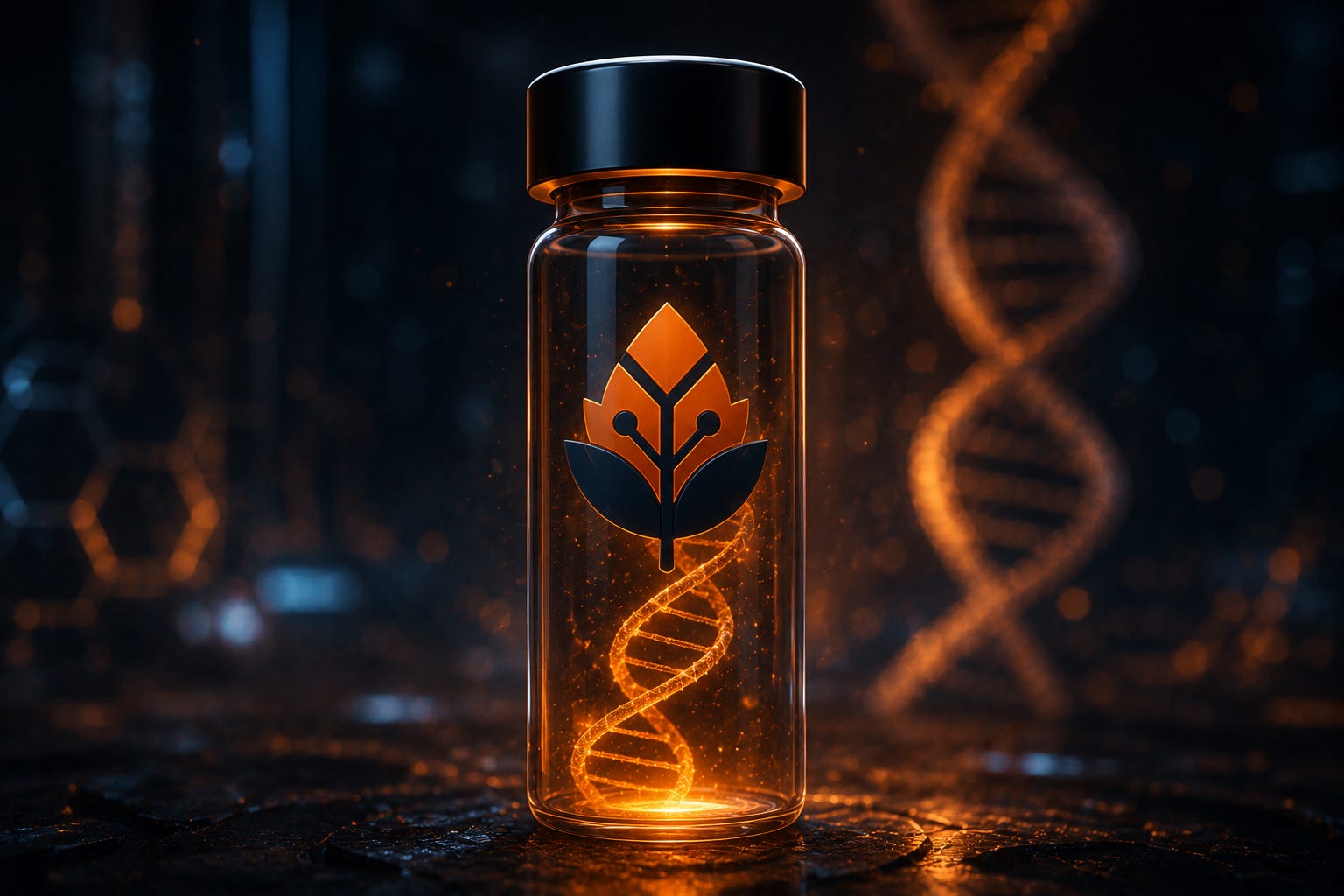
You are no longer just backing up your data. You are creating a biological heirloom.
The Return of the Intentional Ancestor
For the past two decades, consumer technology has trained us to be disposable creators. We post for the immediate hit of the algorithm, leaving behind an accidental, chaotic trail of digital exhaust, broken links, abandoned accounts, and algorithmic profiles designed to sell us ads, not preserve our essence.
By shifting our perspective toward deep-time preservation, we change how we interact with our own minds today.
When you write with the knowledge that your thoughts can be encoded into a medium that will outlast the building you are sitting in, you become an intentional ancestor. You stop logging noise, and you start archiving signal. You begin to ask: If a descendant five generations from now reads the biological file of my life, what is the core philosophy they need to inherit?
Substrate Independence: The Portable Identity Framework
For the transhumanist, the cryopreservationist, or anyone thinking in centuries rather than software cycles, archiving data is only half the battle. The real challenge is compatibility.
If you preserve a mind, but it is locked inside a proprietary, closed-source cloud database, it is functionally dead. If the company goes bankrupt, or if the AI architectures of the year 2126 cannot read the relational schema of 2026, the thread of continuity snaps.
To solve this, Embermind treats the MindFile not as a static document, but as a portable identity framework.
By compiling your daily memory logs, philosophical stances, and the neural weights of your Synaptic Graph into a standardized, open-source, and non-proprietary matrix, the MindFile achieves complete substrate independence.
THE PORTABLE IDENTITY FUTURE
──────────────────────────────────────────────────────────
                     ┌──► Local Large Language Models (LLMs)
                     │
[ Biological DNA ] ──┼──► Synthetic In-Silico Neural Nets
  Archive Core       │
                     ├──► Anthropomorphic Android Substrates
                     │
                     └──► Quantum-Compute Virtual Environments
──────────────────────────────────────────────────────────
It does not matter if the dominant computing substrate a century from now is silicon, quantum, or biomorphic. Because the underlying data is stored as a raw, mathematically mapped vector space of your identity, it is fundamentally “plug-and-play” for future intelligence.
If you are undergoing cryopreservation, your MindFile acts as an informational bridge, a cold-stored, biological backup of your cognitive architecture that can be decoded and loaded into a synthetic neural network or localized clone long before biological revival is technically viable. If your goal is purely generational legacy, it ensures that your great-great-grandchildren won’t just read your words; they can deploy your MindFile into whatever local ambient AI assistant exists in their era, allowing them to converse with a high-fidelity digital twin that possesses your exact context, values, and memories.
We are decoupling identity from hardware. By encoding a sovereign, portable framework into a biological medium, Embermind ensures that your essence is ready for whatever substrate humanity builds next.
Start your MindFile today @ EMBERMIND.