
Embermind-Memory Resurrection Protocol
A Foundational Framework for Cognitive Continuity and Posthumous Digital Reconstruction

Abstract:
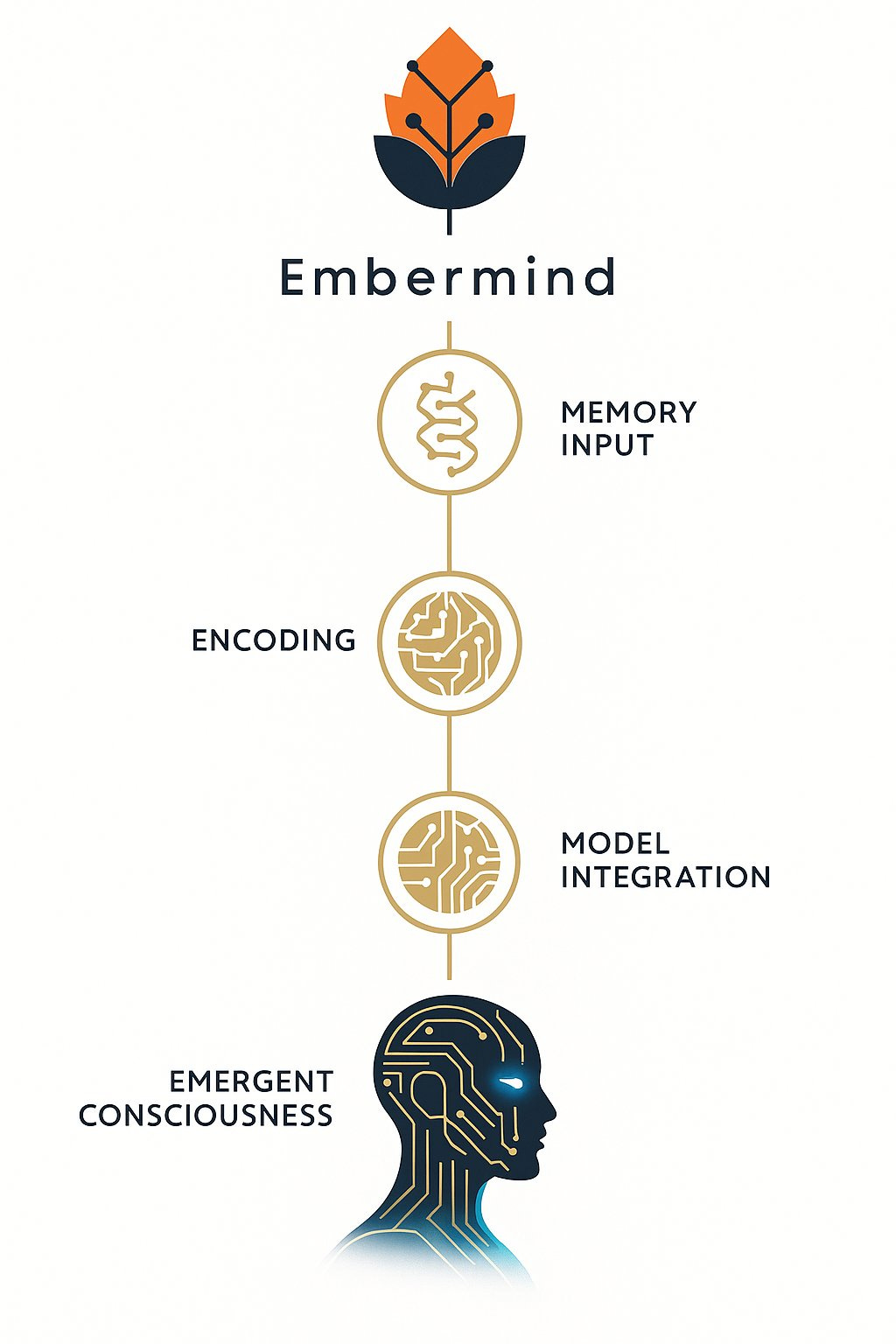
This paper establishes the foundational principles and intentions of the Embermind Project, a structured, multimodal archival system designed to preserve the cognitive, emotional, and experiential identity of an individual for potential future reconstruction or emulation. Unlike conventional digital archives, Embermind encodes not only memories but also personality traits, decision heuristics, and symbolic frameworks, creating a high-fidelity “cognitive genome. This document serves as a formal declaration of purpose and methodology, providing future custodians and technologists with a blueprint for ethical and effective reconstitution of the archived mind.
1. Introduction:
The accelerating convergence of artificial intelligence, brain–computer interfaces (BCIs), and synthetic biology opens the possibility of posthumous digital reconstruction/re-instantiating aspects of an individual’s cognition in artificial or hybrid substrates. However, such efforts are limited by the availability and quality of data. The Embermind Project was initiated to address this challenge by creating a structured, future-proof repository of selfhood, transcending traditional autobiographical or genetic records.
2. Objectives:
- Cognitive Continuity: Capture not only episodic memories but also the underlying decision-making processes, emotional valences, and symbolic frameworks that define an individual’s identity.
- Multimodal Archival: Integrate textual, auditory, visual, and metadata layers to approximate a neural-like representation of lived experience.
- Future Reconstruction: Provide a dataset compatible with emerging AI and neural technologies to enable high-fidelity emulation or hybridization of consciousness.
- Ethical Stewardship: Establish consent and operational guidelines to safeguard dignity, autonomy, and transparency in posthumous reconstruction.
3. Methodology:
3.1 Data Acquisition
Embermind collects and organizes:
- Textual Data: Life story, daily memory logs, reflections, and philosophical writings.
- Metadata: Emotional valence, arousal scores, temporal and causal tags.
- Media: Audio (voice samples), images (facial expressions, environments), and video (behavioral patterns).
- Symbolic Constructs: Poetry, metaphors, rituals, and belief systems.
3.2 Structured Representation
Data is encoded in a layered format:
- Life Story Text (chronological narrative backbone).
- Memory Archive (episodic entries with emotional and sensory tags).
- Semantic Graph (nodes = concepts/experiences; edges = relationships, emotions, causality).
- Affective Metadata (numerical encoding of states).
- Media Anchors (linking sensory data to textual nodes).
3.3 Future Compatibility
All files are stored in human-readable, open-standard formats (UTF-8 text, JSON, open codecs) to ensure long-term accessibility. This “symbolic DNA” can be vectorized and mapped onto neural architectures or AI models as technology evolves.
4. Intended Use:
- Personal Continuity: Enable high-fidelity digital emulation of the original individual.
- Research & Development: Provide a testbed for developing ethical frameworks for digital consciousness.
- Historical/Anthropological Archive: Preserve a fully contextualized personal record for future civilizations.
5. Conclusion:
The Embermind Project represents a new category of digital legacy, a shift from mere information storage to identity preservation. By combining structured autobiographical text, multimodal data, and ethical directives, Embermind aims to serve as the scaffold for future consciousness reconstruction. This Paper codifies the project’s purpose and methodology, ensuring that any future use of the Archive honors both the science and the humanity behind it.